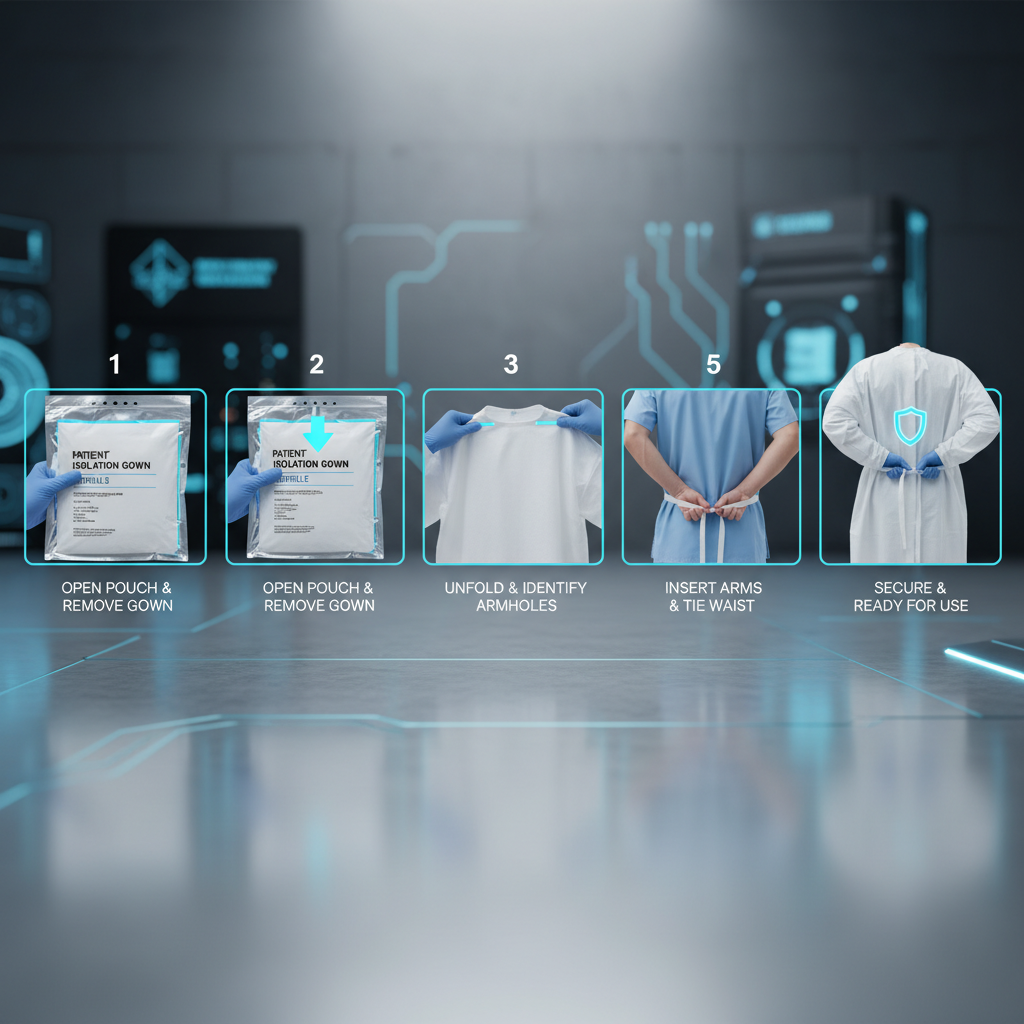
Selecting the right protective barrier in a clinical setting often comes down to a critical balance between fluid resistance and wearer comfort. In high-risk environments, the margin for error is slim, making the choice of materials and construction methods a primary concern for infection control officers.
The shift toward single-use PPE has accelerated as healthcare facilities prioritize the elimination of cross-contamination risks associated with laundering. This transition has placed a significant spotlight on the technical capabilities of disposable isolation gown manufacturers, who must now meet stringent international standards for permeability and durability.
Understanding the interplay between fabric weight, barrier levels, and regulatory certifications is essential for procurement managers. This article examines the technical benchmarks and selection frameworks necessary to optimize safety protocols within modern medical facilities.

Evolution of Barrier Protection in PPE

Early isolation garments relied heavily on reusable cotton blends, which, while breathable, lacked the necessary hydrostatic pressure resistance to stop viral particles and fluid splashes. The emergence of non-woven technology revolutionized this sector, allowing for the creation of synthetic fibers that could be bonded through thermal or chemical processes.
Modern production focuses on SMS (Spunbond-Meltblown-Spunbond) structures. This composite layering provides the structural strength of spunbond fabrics with the filtration efficiency of meltblown layers, fundamentally changing how hospitals manage contagion risks.
Material Engineering and Fluid Resistance
The efficacy of a gown is determined by its "breathability" versus its "barrier" property. Polypropylene remains the gold standard due to its hydrophobic nature. By adjusting the denier of the fibers and the density of the meltblown core, manufacturers can tune the garment to either be highly breathable for low-risk triage or completely impermeable for surgical interventions.
Seams are often the weakest point of any garment. Advanced ultrasonic welding has largely replaced traditional stitching in high-performance gowns, as it fuses the fabric together without creating needle holes. This ensures that the barrier is continuous from the neck to the cuffs, reducing the risk of seepage during heavy fluid exposure.
Beyond fluid resistance, biocompatibility is paramount. The use of medical-grade resins ensures that the garments do not cause skin irritation during extended wear, a factor that is often overlooked but critical for maintaining healthcare worker compliance with PPE protocols.
The Critical Role of AAMI Levels
To standardize the selection process, the Association for the Advancement of Medical Instrumentation (AAMI) established four distinct levels of protection. These levels are not merely labels but are based on rigorous testing for synthetic blood penetration and hydrostatic pressure.
The core challenge in PPE procurement is avoiding "over-specification," where Level 4 gowns are used for Level 1 tasks, leading to unnecessary waste and increased costs without adding clinical value.
Level 1 and 2 are generally suitable for minimal risk or low-fluid environments, whereas Level 3 and 4 are reserved for procedures with a high probability of fluid splashes. Selecting the correct level requires a precise risk assessment of the specific clinical task at hand.
Comparative Performance Indices
When evaluating different fabric types, procurement teams often look at a relative performance index. This index weighs the trade-off between the hydrostatic head (the pressure a fabric can withstand before leaking) and the moisture vapor transmission rate (MVTR), which dictates how much sweat can escape the gown.
A higher value in the barrier index typically correlates with a lower value in the breathability index. Finding the "sweet spot" depends on the expected duration of wear and the ambient temperature of the operating environment.
Figure 2. Material Performance Correlation Index
Operational Deployment Scenarios
In a typical industrial or clinical setting, the deployment of isolation gowns varies by zone. In general wards, a lightweight, breathable gown is sufficient for basic patient contact. However, in the Intensive Care Unit (ICU) or during an emergency intubation, a reinforced barrier is non-negotiable.
The logistical challenge for many facilities is maintaining a diverse inventory. To streamline this, some organizations are moving toward a "universal" gown that meets Level 2 or 3 standards, accepting a slight decrease in breathability to ensure that all staff are adequately protected across most common scenarios.
Sustainable Trends in Disposable Textiles
The environmental impact of single-use polypropylene is a growing concern for global health systems. This has led to research into biodegradable polymers and bio-based non-wovens that maintain the same barrier properties as traditional plastics but decompose more rapidly in landfill conditions.
Current innovation is also focusing on "circular" supply chains, where disposable gowns are collected and chemically recycled back into raw polymer pellets. This approach attempts to decouple the necessity of disposable safety from the long-term ecological cost of plastic waste.
Furthermore, the integration of smarter materials—such as those that change color when saturated with fluid—is being explored. This would provide an immediate visual cue to the healthcare worker that the barrier has been compromised, enhancing the safety loop through real-time feedback.
Procurement Selection Framework
Evaluating disposable isolation gown manufacturers requires a move beyond simple price-per-unit analysis. The true cost of ownership includes the rate of failure (tears or leaks) and the impact on staff productivity due to heat stress.
A robust evaluation framework focuses on certification transparency. It is not enough for a manufacturer to claim "AAMI Level 3"; they should provide the corresponding test reports from accredited third-party laboratories to verify the results.
Ultimately, the choice should be guided by a matrix that maps the specific clinical risk against the material's verified performance. This ensures that the facility maximizes safety while optimizing its operational budget.
| Risk Level | Recommended Level | Material Type | Key Consideration |
|---|---|---|---|
| Minimal Fluid | AAMI Level 1 | Spunbond PP | Maximum Breathability |
| Low Fluid | AAMI Level 2 | SMS Composite | Balance of Comfort/Protection |
| Moderate Fluid | AAMI Level 3 | Reinforced SMS | Hydrostatic Resistance |
| High Fluid | AAMI Level 4 | Laminated PE/Film | Complete Impermeability |
| Long Duration | Level 2/3 | High MVTR Fabric | Heat Stress Mitigation |
| Emergency/Rapid | Level 3 | Easy-donning SMS | Speed of Deployment |
Questions & Answers
Spunbond is a single-layer fabric that provides basic coverage and is highly breathable, but it offers limited fluid resistance. SMS (Spunbond-Meltblown-Spunbond) is a three-layer composite where the middle meltblown layer acts as a high-efficiency filter to block particles and liquids, while the outer spunbond layers provide strength and durability. Most high-quality disposable gowns use SMS for better protection.
Perform a risk assessment based on the likelihood and volume of fluid exposure. Use Level 1 for basic exams, Level 2 for low-fluid tasks, Level 3 for procedures with occasional splashes, and Level 4 for high-volume fluid exposure like surgical cases. Always match the gown's barrier property to the highest potential risk of the specific task to ensure staff safety.
From a cross-contamination perspective, disposable gowns eliminate the risk of residual pathogens remaining after laundry. They also provide more consistent barrier performance since they do not degrade over multiple wash cycles. However, reusable gowns have a lower long-term environmental footprint. The choice depends on whether the priority is absolute sterile assurance or environmental sustainability.
Traditional sewing creates thousands of tiny needle holes along the seams, which can act as entry points for fluids and bacteria. Ultrasonic welding uses high-frequency vibrations to fuse the synthetic fibers together without needles or thread. This creates a seamless, waterproof bond that significantly enhances the overall barrier integrity of the garment, especially in Level 3 and 4 gowns.
High-barrier gowns can trap heat and moisture, leading to discomfort and heat stress for the wearer. This often results in staff attempting to "vent" the gown or failing to wear it correctly, which compromises safety. Selecting materials with a higher Moisture Vapor Transmission Rate (MVTR) for long procedures helps maintain wearer comfort and ensures stricter adherence to PPE protocols.
Look for ISO 13485 certification, which ensures the manufacturer follows a quality management system specific to medical devices. Additionally, verify that products have CE marking or FDA clearance. Most importantly, request the actual test reports for AAMI or ASTM standards to confirm that the fluid resistance and durability claims are backed by verified laboratory data.
Final Thoughts
The technical landscape of medical protective apparel has evolved from simple coverage to highly engineered barrier systems. By focusing on the synergy between material science, seamless construction, and standardized AAMI levels, healthcare facilities can create a safety environment that protects both the patient and the practitioner.
As the industry moves toward more sustainable alternatives and smarter textiles, the core requirement remains unchanged: the provision of reliable, validated protection that does not compromise the operational efficiency of the medical professional.